
Iron County Release Meanings
The Iron County Jail holds several kinds of people. Some await court. Others serve local terms, occupy Utah Department of Corrections contract beds, or remain under a federal hold. A name leaving the current roster proves only that the person is no longer displayed there at that refresh. It does not identify a release time, legal reason, or destination. The next record must answer those points.
An ordinary Iron County detainee might leave after cash or surety bond, dismissal, a judge's order, credit for time served, or completion of a county sentence. A state prisoner can leave the jail through transport to another UDC site while remaining confined. A person held for the U.S. Marshals Service can also be moved without entering the community. Juvenile departures are governed by JJYS and Juvenile Court privacy rules. Each path has its own record custodian.
- Bond
- Release before the case ends after the court's financial and other conditions are met.
- Time served
- A departure tied to the jail time credited under a judgment or commitment.
- Parole
- Release from prison confinement under UDC supervision and Board conditions.
- Probation
- A court-ordered community sentence that may begin without a prison release.
- Discharge
- The end of the applicable sentence or supervision, supported by a termination or expiration record.
- Transfer
- Departure from one site while government custody continues elsewhere.
Iron County Release Types
The label matters because it controls where the person appears next. A county booking record should be read with the court order and any receiving-authority record. Death ends custody but must not be described as a community release.
| Event | Meaning | Best next record |
|---|---|---|
| Cash or surety bond | The case continues after release under court terms. | Iron County release record and the court docket |
| Time served or sentence complete | A local term or credited term ended. | Jail timestamp, judgment, and commitment |
| Court ordered or dismissed | A judge acted, though another hold may still apply. | Signed order plus jail disposition |
| Parole | A state prisoner entered supervised community status. | UDC Release Date/Type and BOPP order |
| Transfer | Iron County custody ended but other custody continued. | Release destination and receiving agency record |
| Expiration or termination | The relevant state sentence or supervision ended. | UDC historical record and Board order |
A probation label differs from parole. Probation reflects a court sentence managed in the community, while parole follows release from a state prison term. Neither label should be replaced with the broad word “free.”
Iron County Release Record Fields
The strongest local record is tied to one booking number. It joins the admission and exit facts and can distinguish release from transport. Iron County's online roster does not show this full inventory, so a records request is needed when the exact event matters.
| Field | What it shows |
|---|---|
| Booking number | Links the request to one custody episode and reduces mistaken identity. |
| Admission date and time | Marks when that booking began. |
| Release date and time | Shows when Iron County ended that booking. |
| Release or disposition type | Names bond, time served, court action, transfer, or another coded event. |
| Releasing authority | Identifies the court or agency behind the action. |
| Charges and bond | Connects the exit to the pending or completed case. |
| Transfer destination | Shows another custodian when that public field exists. |
A court docket supplies a different layer. It can show dismissal, judgment, sentence, credit, and an order that affects custody. It may not show the minute jail staff completed the exit. The most reliable account pairs the jail release timestamp with the relevant court or receiving-agency record.
Note: “In Custody: No” is a departure clue, not a release type or proof that all government custody ended.
Request Iron County Release Records
The Iron County Sheriff record request is the official fallback when public pages stop short. Ask for an existing record, not a new explanation. Give enough detail to isolate the booking, and request segregable public portions when part of a record is restricted.
- Identify the full name, aliases, approximate booking date, booking number, charges, and arresting agency when known.
- Request the admission and release times, disposition type, releasing authority, and public transfer destination for that booking.
- Select electronic delivery if useful, set a cost ceiling, and ask for an estimate or a lawful fee waiver before added work begins.
- Submit identification only when the access rule for a private or protected record requires it.
- Compare the returned record with the matching court order or receiving-agency status.
The form states that a response may take up to ten business days. Search, retrieval, and administrative costs may apply, and full estimated payment may be required. Current rates should be confirmed at 435-867-7500. The Sheriff's business office is at 2132 N Main Street in Cedar City and is open Monday through Thursday, 8 a.m. to 4 p.m., and Friday, 8 a.m. to 2 p.m., except holidays. The jail line is 435-867-7555.
The official request form can be reviewed before filing. It shows the identity, delivery, fee, and waiver choices that shape an Iron County release-record request.
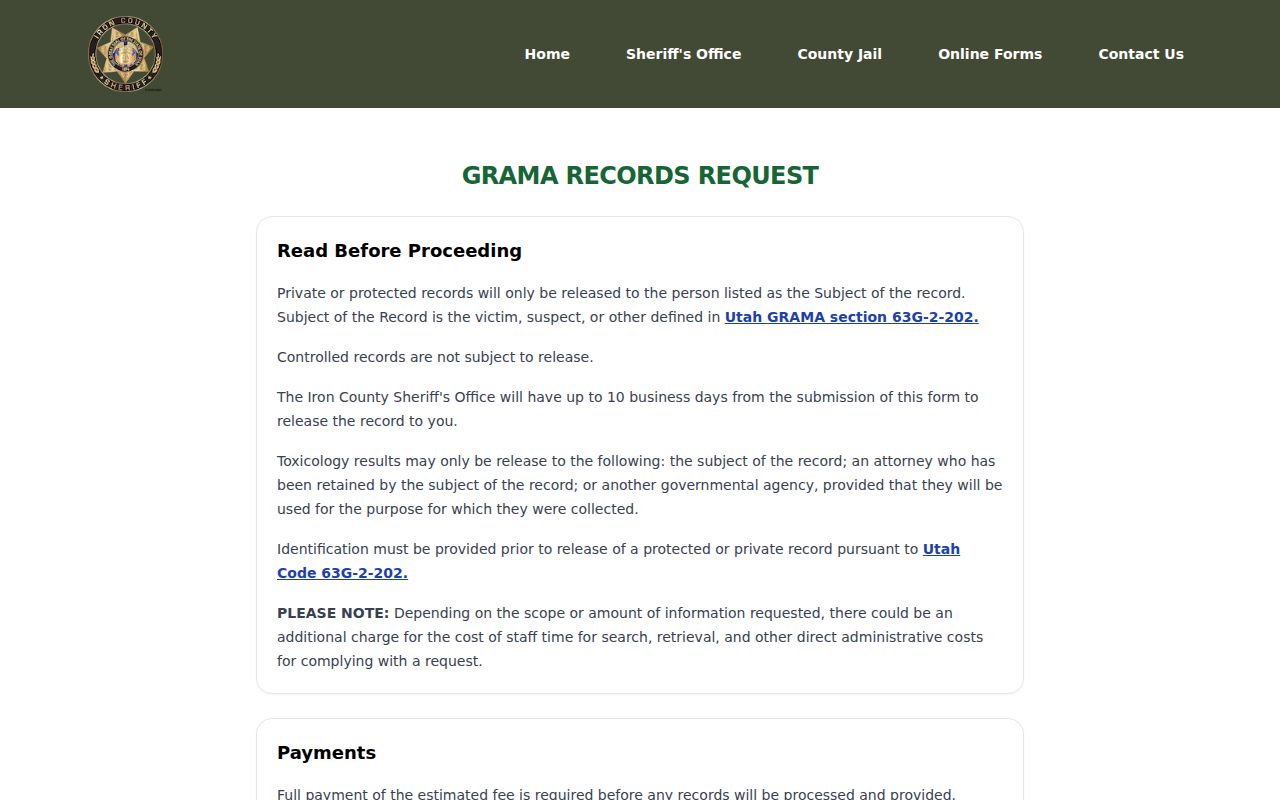
The pictured form is the route for an authoritative booking-and-release record when the live jail pages cannot explain a departure.
Iron County Release Record Law
Utah's Government Records Access and Management Act, or GRAMA, directs a requester to the government entity that keeps the record. The written request must include contact information and describe the record with reasonable specificity. Section 63G-2-204 provides the ordinary ten-business-day response track, while a supported public-benefit expedited request uses five business days. Extraordinary circumstances can extend the date with an explanation.
Release facts are not all treated alike. Juvenile, victim-identifying, medical, security, active-investigation, sealed, and expunged material can be restricted. An agency should still provide segregable public fields when possible. It does not have to create a new report or compile an answer that is not already maintained. A denial can be appealed first through the entity's chief administrative officer.
Note: A custodian may withhold protected parts while still releasing public portions that can be separated from the same record.
Bonding Out in Iron County
The Iron County bail process accepts cash or a surety bond at the jail. A cash bond may also be paid by credit card through JailATM. Full payment at the jail may use cash, a cashier's check, or a money order made payable to the court that has jurisdiction. Personal checks are not accepted, and the payer must show government photo identification. The jail can also accept an out-of-county cash bond.
After bond is posted, the defendant receives a future court date and is released, according to the Sheriff. That event does not dismiss the charge. It means the case moves forward outside the jail under court terms. Confirm the correct court before reading a docket or naming a payment destination, especially when Iron County accepted bond for a case filed elsewhere. The jail record should still supply the release time and type.
Iron County Release Court Records
Iron County cases can sit in different courts. Fifth District Court handles felonies and class A misdemeanors. Iron County Justice Court generally handles class B and C misdemeanors, infractions, and local or traffic matters. Utah Courts Xchange searches public district and justice records, while MyCourtCase gives a party free access to linked open or closed cases. The local Justice Court also accepts a detailed records request and provides a virtual jail-hearing contact.
Start with the case number, charge class, booking agency, and court of jurisdiction. Then read the order for bond, dismissal, sentencing, or credit for time served. A judicial order explains legal authority, but another hold may prevent immediate physical release. For that reason, the order and sheriff exit record should be read together. This is especially important for out-of-county bonds and for people booked on more than one case.
Note: A court disposition can prove judicial action without proving the exact hour Iron County staff completed a release.
Expunged Iron County Release Records
Since January 1, 2026, Utah courts identify cases that qualify for the current automatic-expungement process. Expungement seals government records. Xchange removes an expunged case, while MyCourtCase may show the person a “Case Expunged” entry. Thus, a missing public case can reflect a lawful seal rather than proof that no booking or court matter existed.
Other causes also matter. Xchange may omit protected cases, old justice records that predate CORIS, juvenile matters, a misspelled name, or a search in the wrong county. Petition-based waiting periods vary by offense and are measured after release from incarceration, parole, or probation, whichever comes last. Current eligibility and exclusions should be checked against the Utah Courts expungement guide and Utah Code, rather than reduced to one general waiting period.
Find Iron County Released Inmates
A sound search begins with custody type. The Iron County current roster answers only whether a person is displayed as held at the refresh. The rolling recent-bookings page covers bookings from the last three days and adds an In Custody flag. Neither page is a historical release list.
- Search the current roster and recent bookings. Record the booking date, agency, charges, bond, booking number when shown, and current-custody flag.
- Identify the court. Check Xchange or use MyCourtCase for the person's own linked case, then obtain the order or disposition.
- Test UDC when the person received a state sentence, occupied a contract bed, or may have moved to state custody.
- Use BOPP decisions and Cedar City AP&P when parole or probation is shown.
- Follow BOP, USMS, or ICE only when the actual booking or case establishes that connection.
- Request the sheriff's booking-and-release record when the online trail does not identify the event.
When the goal is current post-release status, the Iron County parole and probation page explains how UDC, BOPP, and the Cedar City office divide that work.
Iron County UDC Release Search
The UDC Offender Search covers people currently in state custody or under UDC supervision. Search by offender number when possible because it best separates people with similar names. A name search requires at least one letter in both the first and last name fields, with an optional middle name.
| UDC field | How to read it |
|---|---|
| Offender number | The strongest public identifier for the state record. |
| Location | A prison or contract site means confinement; PAROLE or PROBATION means community supervision. |
| Housing Facility | A named site indicates placement; N/A can accompany community status. |
| Release Date/Type | The exact public label for a date and type, which may be a parole date or N/A. |
| Case Manager | Identifies the supervision or case-management path when displayed. |
| Case Manager Email | Provides the listed state contact for that record. |
Read Location before the date. PAROLE with Housing Facility N/A supports release from prison confinement to supervision. PROBATION does not prove a prior prison release. A future date can change through a Board rescission, unmet release condition, recalculation, misconduct decision, or earned-time action. Full discharge can also remove a person from the current-supervision search, so BOPP decisions and a UDC historical-record request become the fallback.
The state search interface shows how Iron County state cases are separated from ordinary county-jail bookings.
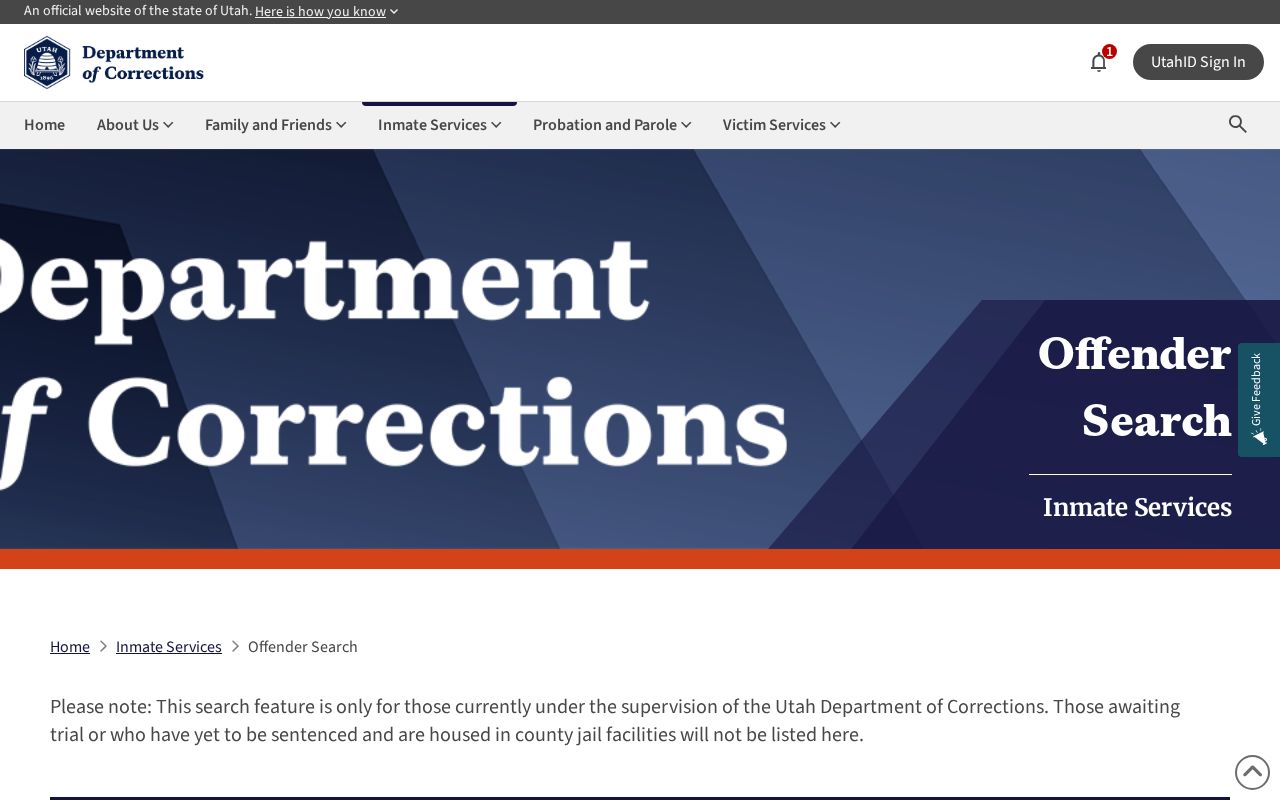
Its Location and Release Date/Type fields must be read together before describing a state release.
Note: UDC's current-supervision scope means completed discharge may require a historical request and a Board termination or expiration order.
Iron County Recent Release Clues
Iron County publishes no exact 24-hour or 72-hour release feed. The Sheriff's recent-arrests page is a rolling three-day list of bookings, ordered by booking time. It refreshes every ten minutes and shows Name, Agency, Arr. Type, Book Date, Offenses, and In Custody. Its public data can also expose booking number and offense statute or count.
An In Custody: No value is useful, but narrow. It does not state the exit date, release reason, court authority, or destination. The window is based on when booking occurred, not when release occurred, so an older booking can disappear even after a recent exit. No public sheriff jail app or hidden release archive was found in the official navigation and source sweep. The correct next step is the GRAMA request, not relabeling the booking page.
Iron County Release Supervision Programs
AP&P supervises Utah parolees and probationers, while BOPP makes state parole and sentence-termination decisions. A UDC PAROLE location and the case manager fields are the main public online confirmation after prison. A PROBATION location confirms probation supervision. Neither result alone should be described as complete discharge.
Iron County's UDC jail-program listing documents local programs such as Inside Out Dad, school-district diploma work, AA/NA, faith services, ESL, structured cell study, Hustle 2.0, and tablet classes. It also says the contracted UDC work-placement group performs culinary and maintenance work and may save funds for release. The Sheriff's Drug Court is a separate local court and supervision path. These resources describe available structure, not a promised result or automatic reduction in custody.
Note: Program participation and saved funds do not by themselves establish parole approval, a release date, or completed supervision.
Transportation After Iron County Release
Cedar Area Transportation Service marks stop 16C as “2132 N Main - ICSO,” beside the jail at 2136 N Main. The published map includes weekday and Saturday trips. That gives a person released during covered service a practical daytime route from the Sheriff's Office area.
The bus is public transit, not transportation arranged by the jail. Service does not cover every possible release time, and the research found no official county release-hour or exit-door policy. Check the current CATS schedule before relying on the stop, and make another plan for gaps. State-prison release transportation follows UDC's separate Release Day process, usually at USCF, rather than this local route.
Iron County Jail Release Context
County materials state that the current jail was built in 1987 and discuss crowding, design limits, and a proposed replacement campus. The proposal must not be mistaken for a completed move. Current Sheriff pages still direct the public to 2136 N Main Street, and that remains the address tied to the public roster, jail contact, and release-record process.
The facility's role also explains why a roster change can be hard to read. Iron County participates in UDC's Inmate Placement Program, and the official jail-program book identifies 256 beds with ten contracted or available male UDC beds. A state-sentenced person may be physically housed at the jail but legally remain a UDC prisoner. UDC says nearly all state inmates in county contract beds are moved to USCF for release processing. A move out of the Iron County roster may therefore be a state transport, not a community release.
Compare Iron County Release Sources
Released and still-in-custody records answer different questions. A current roster is a snapshot. A release record is a dated event. A supervision record describes the status that follows.
Current Iron County custody: Use the Sheriff roster. Presence supports custody at that refresh; absence proves no release reason.
Recent local departure: Use the three-day booking clue, then request the booking-and-release record and check the court order.
State prison or supervision: Use UDC Location and Release Date/Type, then the BOPP decision. A parole result is not full discharge.
Federal or immigration status: Use BOP or ICE only when a booking, hold, or court record supports that custody type.
Historical court outcome: Use Xchange, MyCourtCase, or the correct clerk, while accounting for sealing and expungement.
Iron County Release Facilities
Five facilities or serving institutions shape Iron County release questions. Their roles are not interchangeable.
Iron County Jail: The adult county jail. Ordinary exits are confirmed by Sheriff release records, while state and federal holds require the matching outside agency.
Southwest Utah Youth Center: A locked JJYS youth facility. Placement and discharge information uses authorized juvenile channels, not public adult searches.
Iron County Youth Center: A JJYS receiving and youth-services center. A departure is a juvenile service or court-placement matter.
Utah State Correctional Facility: UDC's normal state release-processing site, including most people transported from county contract beds.
Central Utah Correctional Facility: A UDC prison in Gunnison. Most actual state release processing still occurs through USCF.
The county of conviction does not fix the final destination. A person may parole to an approved Iron County address and report to Cedar City AP&P, enter a community correctional center elsewhere, transfer to another custodian, or complete a sentence. Confirm the named person's actual record.