
Iron County Released Mugshot Status
A mugshot, also called a booking photo, is made during an arrest or custody intake. In Utah, the image is not automatically open merely because other booking facts can be viewed. Utah Code §63G-2-305(80) generally protects a jail booking image unless a listed exception applies. One key exception concerns a conviction based on the booked conduct. Iron County’s own policy follows this rule and directs post-conviction or post-sentencing requests through GRAMA.
The release record and photo record answer different questions. A release record can show the date, type, authority, and destination. A photo identifies the image associated with an intake. Neither the photo nor its continued appearance proves that the charge remained, that the case ended in conviction, or that the person entered the community on a certain date. Verify identity and disposition through the Sheriff and correct court before describing the image.
Juvenile records use restricted JJYS and Juvenile Court channels. Adult roster, UDC, and photo rules must not be used to expose a youth record.
Iron County Released Photo Channels
Each image source has its own scope. The Sheriff roster is useful for custody facts but contains no photo. A UDC prison image relates to a state corrections record and is not automatically the same image taken at the county jail.
| Channel | Photo available? | How to access or interpret it |
|---|---|---|
| Iron current roster | No | Current booking data only; no photo field or release archive |
| Iron recent bookings | No | Three-day booking clues and a dated county photo-policy notice |
| Sheriff mobile app | None found | No official public Iron County jail app was located in the review |
| Sheriff GRAMA request | Possibly | Form has a booking-photo option; Utah access limits and disposition control |
| UDC public information | Possibly | Prison photo or mug shot may be available for a state prisoner, subject to limits |
| Utah statutory registry | For qualifying registrants | Current registry photo is not necessarily the Iron booking image |
| Official wanted notice or press release | Sometimes | Narrow event source, not a complete released-person archive |
| News or third-party publication | Sometimes | Unofficial lead that may be old; confirm against government records |
VINELink is a custody-notification service, not a promised Iron County mugshot archive. A photo or name there should be interpreted under the source record’s labels. Likewise, a qualifying registry match proves current registration information, not an Iron County release date.
The Utah registry is limited to people whom the law requires to register for specified offenses. Its current photo, address, vehicle, or physical-description fields serve the registry’s statutory purpose. They do not form a general former-inmate photo search, and the image may have been made by a different agency at a different time.
When more than one official image exists, identify each by source and date. An Iron County booking photo, UDC prison photo, registry image, and wanted notice are not interchangeable. Using the correct label avoids implying that an older image proves a later custody event.
Iron County Roster Has No Photos
The current inmate roster displays name, booking date, offenses, bond amounts, and bond types. The three-day recent-bookings view displays name, agency, arrival type, booking date, offenses, and an In Custody value. Neither official page includes a booking-photo field. The recent page’s “In Custody: No” flag can be a departure clue, but it does not release an image or prove what happened after the booking ended.
No public Iron County Sheriff jail-information or inmate mobile app was found after review of official navigation, footer and social links, and app results. The Sheriff links social accounts, but those are not routine databases. Do not substitute a law-enforcement-only service or another Utah county’s app. If the agency launches an app later, verify that it is official and read its photo policy before describing it.
The Iron County 24-hour release process explains how to verify a recent departure without treating the booking feed as a release gallery.
Note: A roster screenshot without a photo is evidence of the interface, not evidence that no booking image exists in agency files.
Request an Iron County Booking Photo
The Iron County Sheriff GRAMA form specifically asks whether a booking photo is sought. A focused request should identify one booking and the court disposition. Release alone is not an access exception, so establish the result of the booked conduct and accept a lawful denial, redaction, or restriction.
- Identify the person, aliases if relevant, booking date, booking number, charges, and arresting agency.
- Identify the related case and disposition, especially a conviction or sentencing tied to the booked conduct.
- Select the booking-photo option and request the existing image in electronic form if lawfully disclosable.
- Ask for segregable public parts and a cost estimate before charges exceed a chosen cap.
- Provide identification only when the requested access category requires it, and sign only truthful use statements.
The form says private or protected records are available only through the access provisions of §63G-2-202, and controlled records are not released. It allows up to ten business days and warns that search, retrieval, or administrative costs may apply. Utah GRAMA §63G-2-203 permits reasonable actual-cost fees and fee-waiver requests. No blanket photo price should be inferred from the county’s separate fee schedule.
The official Iron County photo-request form shows the dedicated checkbox and request fields.
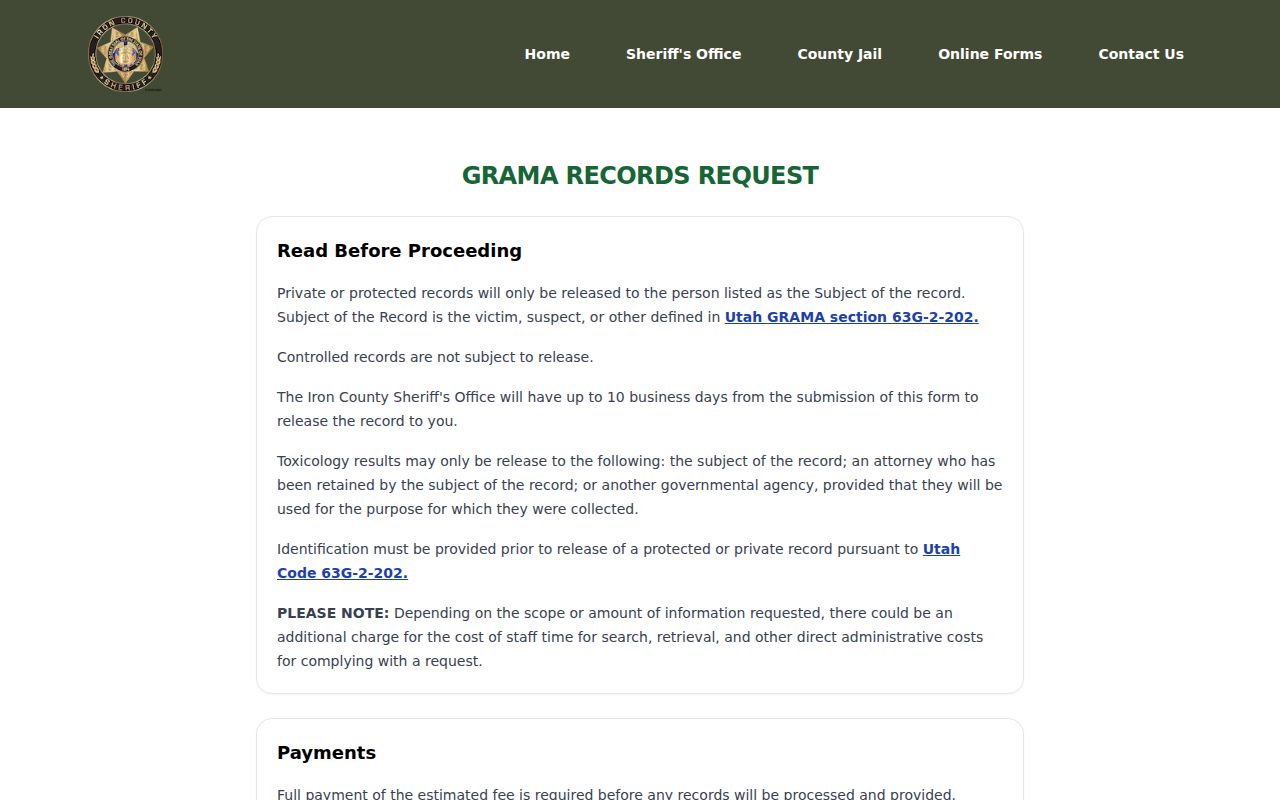
The form is the proper county channel when the online roster has no photo and the statutory disclosure conditions may be met.
Iron County Photos Beyond Agencies
An official wanted notice may contain an image when the Sheriff invokes its wanted-fugitive or imminent-threat exception. Official social posts and press releases are event-specific. They are not a full photo archive, and an image in one post does not establish the final charge result or release status.
Local news may preserve an image that was lawfully published when a case was active. Coverage is selective. An independent article can also remain after government records are sealed or expunged because a government expungement order does not erase a publisher’s archive. Verify the identity, image type, publication date, and court outcome before connecting an old photo with a current claim.
Third-party listings are unofficial leads only. They can retain stale charges, use an image from a different custody system, or confuse people with similar names. No commercial mugshot publisher, data broker, or paid removal service is linked or endorsed. Official Sheriff, court, UDC, and registry records have priority when sources conflict.
Utah Mugshot Removal Rules
Utah Code §17-72-802 regulates sites that publish booking images and charge for removal. After an ordinary request, a covered publisher generally must remove and destroy the image within 30 calendar days and cannot condition removal on more than $50. Proof of acquittal, no prosecution, expungement, vacation, or pardon triggers a seven-calendar-day deadline with no removal fee. The statute also provides remedies and costs in covered cases.
Those private-publication rules are separate from government disclosure. They do not force the Sheriff to provide a protected image. Utah also limits a sheriff’s supply of a copy destined for publish-for-pay use and requires a signed statement. A knowingly false statement can carry legal consequences. Use the statute’s actual terms and do not misstate a removal request as a right to new disclosure.
An official source should be contacted through its own correction or records process. For a private publication, address the publisher directly under the applicable Utah rule. No paid intermediary is required or endorsed.
Iron County Mugshot Policy Since 2021
Iron County publishes an unusually clear local policy. Routine booking-photo posting and distribution stopped on March 18, 2021, following HB 228. Before conviction, the stated public-safety exceptions are narrow and include a wanted fugitive or an imminent threat. After conviction or sentencing, the county directs requesters to GRAMA.
This policy explains why a name can appear in a Sheriff feed without a photo. It also prevents a false promise that every released person has an official image online. Utah Code §63G-2-305(80) and §17-72-802 must be considered along with the county notice. A release event by itself changes none of those access conditions.
For a state prisoner, UDC lists a prison photo or mug shot among public-information categories, subject to privacy and security limits. That route belongs to a UDC case. It does not make UDC the photo custodian for every adult booked at Iron County Jail.
UDC also distinguishes public-information requests from its narrow live offender search. A request can identify the offender number, sentencing case, legal status, and requested photo. Security and privacy rules can still limit disclosure, and UDC need not create a compilation. If the person was only an ordinary county detainee, direct the request to the Iron County Sheriff instead.
A wanted image released before conviction rests on a public-safety exception, not a final finding of guilt. If that image remains online after the case changes, read the current court result before repeating the old caption. The disposition and the reason for initial publication are separate facts.
Iron County Photos After Expungement
Utah’s current automatic-expungement process can make a government court record disappear from Xchange. A released person may see “Case Expunged” in MyCourtCase while the public Xchange entry is removed. Absence from Xchange can therefore reflect legal sealing rather than proof that no booking occurred.
Expungement seals covered government records. It does not automatically erase an independent news image. Photo access, jail release proof, and court visibility remain three separate questions. A protected Sheriff image may be unavailable even when a case was never expunged, while a news image may remain after the government record is sealed.
The Utah Courts expungement guide explains the current process and legal effect. Use the order and current statutes for a specific case. Avoid assuming that a missing court entry is an error or that release alone qualifies a person for expungement.
Verified/accessed August 8, 2026. Booking-photo law, court visibility, and agency policies can change, so check each official source again before making a request.
Public Record Search
Sponsored Results