
Iron County Parole Versus Probation
Utah Department of Corrections Adult Probation and Parole, known as AP&P, supervises both parolees and probationers. That shared agency does not make the two statuses identical. The Utah Board of Pardons and Parole, or BOPP, decides parole and sentence termination for state prisoners. A court imposes probation. The source of the order determines which record is needed.
| Point | Parole | Probation |
|---|---|---|
| How it begins | Release from state prison confinement under a Board order | A community sentence ordered by a court |
| Decision authority | Utah Board of Pardons and Parole | District or justice court, based on the case |
| Public UDC clue | Location may show PAROLE with Housing Facility N/A | Location may show PROBATION |
| Key record | UDC Release Date/Type plus the BOPP order | Court judgment plus current UDC supervision status |
| How it ends | Board termination, expiration, or another formal action | Court completion or other lawful termination reflected in the record |
A parole record proves release from prison confinement to supervision, not full discharge. A probation record proves community supervision, not a prior stay in prison. Both can involve conditions, reporting, and responses to alleged violations. The exact order controls.
- Parole
- Supervised community status after release from a Utah prison sentence.
- Probation
- A court-ordered community sentence that may replace or follow a period in jail.
- Discharge
- Formal completion or termination of the applicable sentence or supervision.
- Absconder
- A supervised person alleged to have stopped reporting or left supervision without permission.
- Rescission
- A Board action that withdraws a release or termination date before it takes effect.
Verify Iron County Release Supervision
The UDC Offender Search is the first public check for a person currently under state custody or supervision. An offender number is the best search key. A name search requires at least one letter in both the first and last name fields and can include a middle name. Compare the result name, date of birth, and offender number before reading the detail page.
- Open UDC Offender Search and identify the correct person by offender number or matching name details.
- Read Location first. PAROLE or PROBATION points to community supervision; a prison or contract facility points to custody.
- Read Housing Facility and Release Date/Type. PAROLE with N/A housing can confirm release from prison confinement.
- Record the displayed case manager and email, then check whether Region 5 is the assigned office.
- For parole, search BOPP decisions by name or offender number and read the actual order and any later action.
- If the live result is absent or incomplete, request the historical status, discharge, or termination record from UDC.
UDC states that its public search covers people currently under its custody or supervision. A person who has fully completed a sentence may no longer appear. That absence cannot be treated as proof of successful discharge. Use a BOPP termination or expiration order, a UDC historical-status record, and the court judgment when needed. The broader Iron County released inmate search path explains how to distinguish this state route from an ordinary county-jail release.
Iron County Parole Supervision Office
AP&P Region 5 lists Beaver, Garfield, and Iron counties. Its Cedar City office is the local contact for appropriate agent-routing or verification questions when that region actually supervises the person. An Iron County conviction or former address does not guarantee a current Cedar City assignment. Read the UDC case manager information before assuming where a person reports.
AP&P Region 5, Cedar City
181 East DL Sargent Drive, Suite B-101Cedar City, UT 84721
Phone: 435-586-5350
AP&P division: 801-545-5908
Coverage: Beaver, Garfield, and Iron counties
The official UDC probation and parole directory is the source for the Region 5 listing. Call for current routing rather than relying on an old office assignment or a county of conviction. No local office hours were supplied in the research, so none should be assumed.
The state AP&P page also shows the Cedar City office in the context of Utah's regional supervision system.
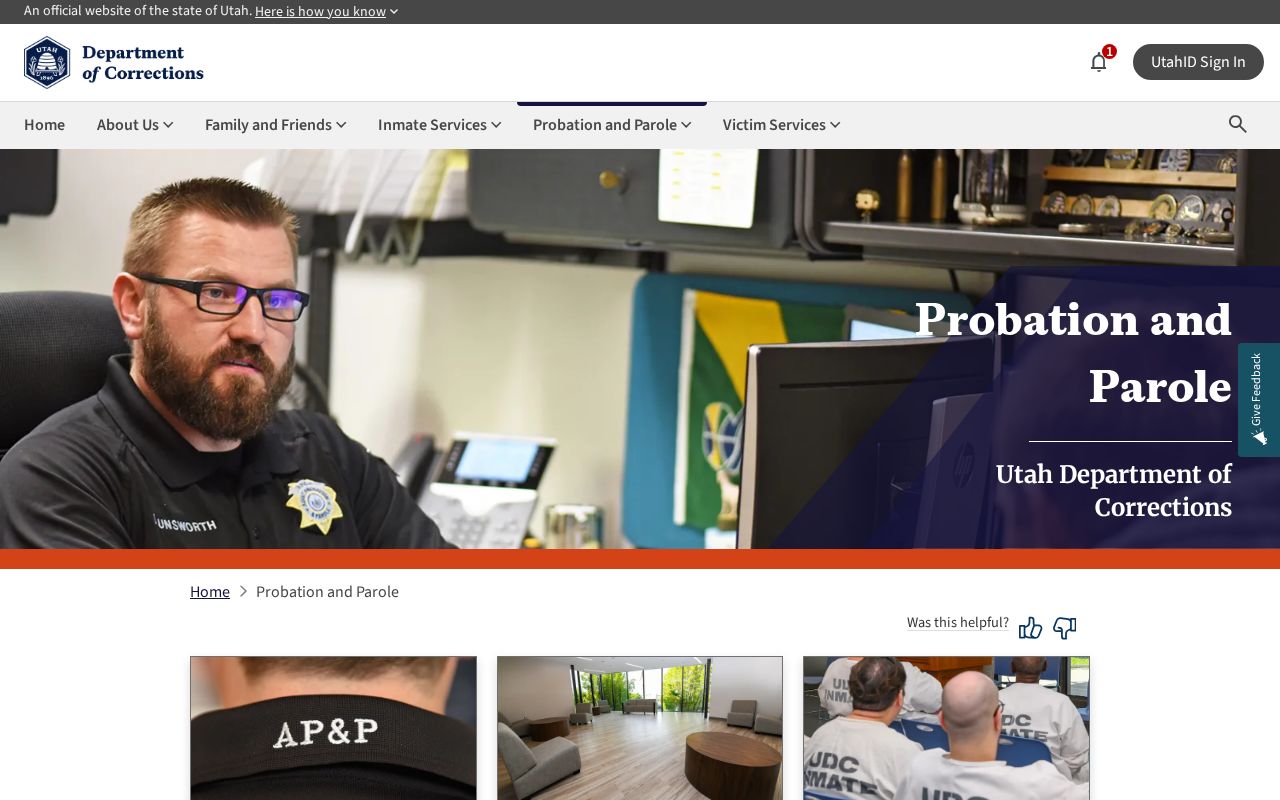
The image supports the office route, while the named person's live UDC record determines whether Region 5 is the relevant supervising office.
Note: A local address or Iron County case does not by itself prove that Cedar City AP&P supervises the person now.
Iron County Parole Board Records
BOPP uses a combined hearings and decisions search. Search by first and last name, offender number, or date range. Name searches include aliases. A date range can show scheduled hearings or prior decisions for the selected period. The posted order is stronger evidence than a tentative schedule, but actual release should still be checked through UDC and AP&P.
Board events have distinct meanings. An Original Hearing, Rehearing, Parole Violation Hearing, Evidentiary Hearing, Redetermination, Rescission Hearing, Paper Review, or Special Attention review can lead to a different order. A future parole date may be rescinded. A violation case can result in reinstatement, a new date, or a return to custody. Avoid reducing every Board record to a simple approval or denial.
Decisions are not made at the hearing itself. Official sources describe ordinary publication in roughly two to six weeks. The Board verification and help line is 801-261-6464. Use that number when the portal result or timing is unclear, particularly when a person may face a later rescission or warrant action.
Note: A scheduled hearing is a decision point, not proof that an Iron County parole release will occur on that date.
Iron County Supervision Conditions
Conditions come from the controlling court or Board order and the supervision plan. They can address reporting, approved residence, travel, treatment, programs, contact limits, and other case-specific duties. The public UDC result may identify a case manager, but it does not replace the full signed order. Read the current order before describing a requirement.
Utah parole operates within an indeterminate sentencing system for many prison terms. The court sets the lawful range, while BOPP considers the offense and case record, sentence structure, conduct, risk, programming, and release plan within its authority. Utah law does not establish one general rule that all people must serve the same share of a sentence. Offense-specific minimums and exclusions can apply under Utah Code §77-27-9.
Earned-time actions also differ from supervision completion. Under §77-27-5.4 and the UDC earned-time program rules, approved programs can affect an ordered date in qualifying cases, subject to limits and possible forfeiture. A program credit does not prove that release happened. After release, only the governing record shows whether parole or probation remains active.
Iron County Parole Warrant Checks
Absconding does not end a sentence. AP&P states that it may seek a warrant and that fugitive teams pursue apprehension when a person absconds. No separate public Iron County or UDC absconder list was found in the source review. A missing UDC search result or an absent jail-roster name must not be reclassified as a completed discharge.
Check the BOPP record for a Board warrant, violation hearing, rescission, revocation, reinstatement, or later decision. Then use the current UDC record and the assigned AP&P office for status. A person may be out of the Iron County Jail yet still be under supervision, held elsewhere, or subject to a warrant. The exact event verb in the order matters.
Utah VINE can send UDC custody-change notices, including prison release, escape and return, death, a parole release date notice, and transfers among state or county contract placements. The official service warns users not to depend on it alone. A VINE alert should be matched with the UDC and Board record before treating it as a confirmed supervision change. Iron County Victim Services can help with local case-status navigation, but it does not replace the custody or Board record.
Iron County Release Support Programs
UDC's Iron County jail-program listing documents several local offerings for people in custody, including Inside Out Dad, school-district diploma work, AA/NA, faith services, ESL, structured cell study, Hustle 2.0, and tablet classes. The same source states that a contracted UDC work-placement group performs culinary and maintenance duties and may save funds for release. These are concrete Iron County program paths, but participation does not guarantee parole or shorten every sentence.
The Iron County Sheriff's Drug Court page describes a separate local program and supervision process. Drug Court should not be confused with ordinary AP&P parole or probation. Its forms and requirements belong to that court-based track. When a record names Drug Court, use its current program instructions alongside the court order and supervising contact.
Iron County has no UDC community correctional center. Utah lists centers in Ogden, West Valley, Salt Lake City, and Utah County. A person can still parole to an approved Iron County address and report through Cedar City AP&P, or move to a center elsewhere if assigned. The release plan and UDC record control the destination.
Note: Local programs can support a release plan, but only the court, BOPP, and UDC records establish legal supervision status.
Iron County Supervision Discharge
Parole ends through a formal Board or sentence event, not through a name leaving the county roster. BOPP can terminate a sentence before expiration, allow expiration, amend conditions, issue a warrant, revoke parole, or rescind a termination date before it takes effect. A “parole date,” a current “PAROLE” location, and a termination order are three different records.
Probation completion should likewise be traced to the governing court and UDC status. Obtain the court order when the sentence was probation. The Iron County Justice Court request serves cases held by that court, while district matters go through the Fifth District clerk. Request a UDC historical record if the current-supervision search no longer returns the person. For state parole, retain the BOPP termination or expiration order and the UDC discharge status. Those sources explain why supervision ended and when the change took legal effect.
Sealing and expungement can later affect public access. Utah's current process may remove an eligible case from Xchange, while the person can sometimes see a “Case Expunged” entry through MyCourtCase. A missing court result therefore does not prove there was no former supervision. Confirm the record through the access channel authorized for that person and case.