
Iron County Three-Day Release Clues
The Iron County Sheriff publishes a three-day list of bookings and arrests, not a 72-hour list of releases. That distinction controls every result. The page is organized by booking age and shows people who entered the jail during the rolling span. It is not organized by the time anyone left. A person booked before the window can be released during it yet never appear there.
The feed’s In Custody field makes it more useful than the current-only roster. A “No” value supports one narrow finding: that recent booking is no longer marked active at the jail. It cannot distinguish bond from time served, dismissal, court-ordered release, transport, UDC placement, or a federal handoff. A three-day scan can find candidates for verification, but it cannot produce a complete weekend release count.
Check Iron County 72-Hour Departures
Begin with the official recent-bookings page. Record the result rather than relying on it to remain available. Both this page and the current roster say they refresh about every ten minutes, but a refresh does not turn the booking list into a formal release record.
- Review all three booking dates in the rolling view, not just today’s entries.
- Match the name with agency, arrival type, booking date, and offenses. Save the booking number if the official data provides it.
- Compare the row with the current roster. “In Custody: No” or roster absence is only the start of confirmation.
- Check the correct Utah court for an order or disposition near the suspected departure.
- Request the jail’s booking-and-release record for the timestamp, type, authority, and destination.
Use the Iron County 24-hour release check when the question is confined to today. Its focus is same-day verification; this wider process is designed to keep a short booking clue from being missed across several days.
Iron County Three-Day Booking Fields
The official interface exposes booking facts and one current-status clue. It does not show the fields expected from an actual Iron County release list.
| Field | Meaning in the three-day view |
|---|---|
| Name | Person identified on the booking |
| Agency | Agency associated with the arrest or arrival |
| Arr. Type | Arrival classification, not a release type |
| Book Date | Date that controls the rolling three-day window |
| Offenses | Charges recorded at booking, not the final court outcome |
| In Custody | Whether that booking is shown as active at the latest refresh |
Missing are the release date and time, release or disposition type, releasing authority, and transfer destination. The public data can also expose the booking number and offense statute or count. Those identifiers help narrow a request, but they do not fill the release gaps.
The Iron County Sheriff interface shows the short window and its custody flag.
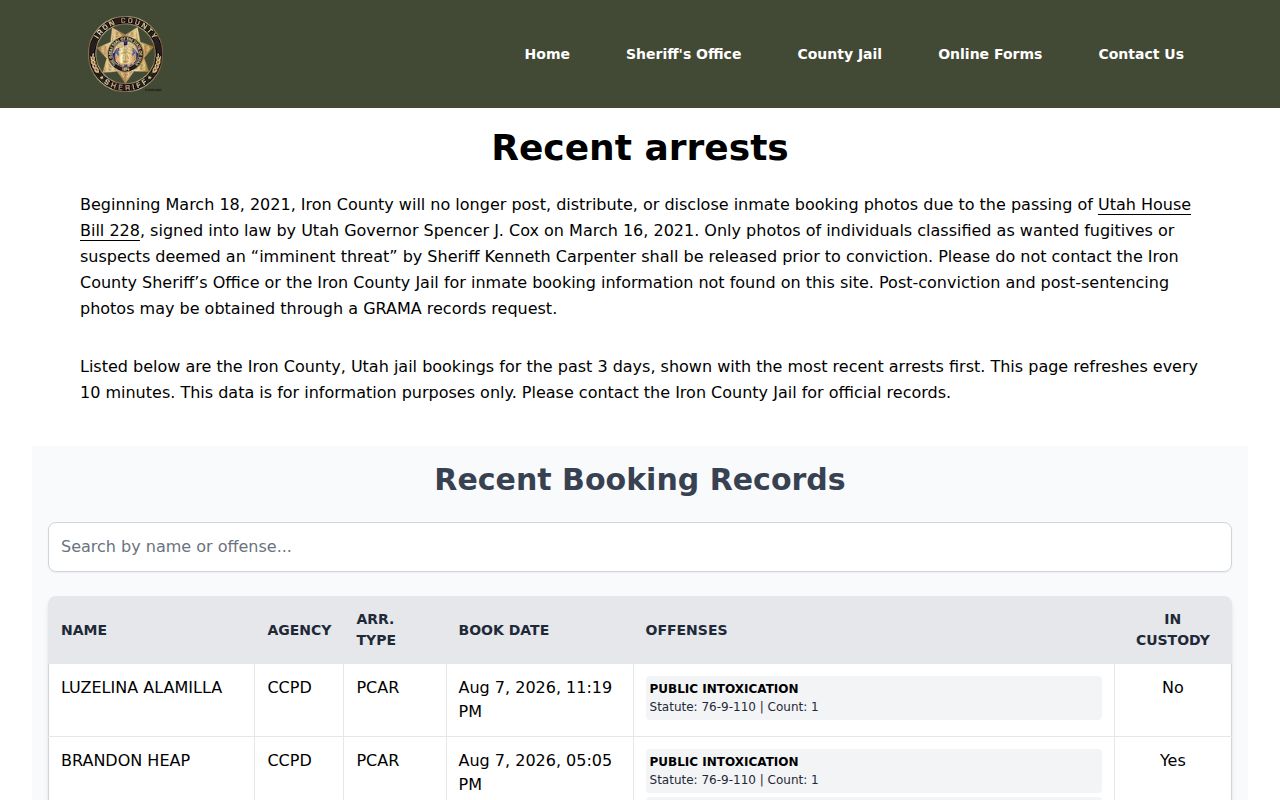
The visible booking-centered fields explain why a Sheriff record request must supply the final release details.
Iron County Weekend Release Gaps
A three-day review is practical around weekends because it reduces the chance of missing a recent booking row before the next workday. It does not create a weekend release schedule. Iron County publishes no official jail rule that moves a Saturday or Sunday release to Friday, and no local release-hour policy was found. Do not estimate a gate time from the booking date.
Court action and jail execution are also separate moments. A docket may show that a judge set bond, dismissed a case, awarded time served, or directed release. Jail staff still must process the order, and another hold may control what happens next. The court record proves judicial action; the booking-and-release record establishes the local exit time and disposition.
For older bookings, the short web feed may contain no row at all. Search the correct court, then give the Sheriff enough admission detail to locate the historical booking. A broad name-only scan is less reliable, especially where similar names or more than one case are involved.
Note: No published Iron County holiday release cadence was found in the official source sweep completed August 8, 2026.
Iron County Release Record Fallback
Submit the Sheriff’s GRAMA form when online clues stop. Identify the person and booking with a full name, aliases if relevant, an approximate booking date, booking number, charges, and arresting agency. Ask for the existing admission and release timestamps, release or disposition type, releasing authority or court, and public destination. Request segregable public parts in electronic form.
The form states that processing can take up to ten business days. Search or administrative charges may apply, and the office can require an estimated amount first. Current cost details can be checked through the Sheriff business line at 435-867-7500. Utah GRAMA permits reasonable actual-cost fees and provides grounds to request a waiver, but it does not force an office to create a custom explanation.
When the record indicates a state case, search UDC by offender number or name. A prison or contract-jail location means continued state custody. A PAROLE location may confirm departure from prison confinement into supervision. For a federal marker, use the federal docket and the relevant federal agency. Utah VINE is a useful alert channel for documented UDC cases, yet Iron County Jail’s own direct participation was not confirmed in the reviewed official material.
A court search can remain useful after the booking row expires. Utah Xchange covers public district and justice case entries and may show charges, hearings, judgments, outcomes, and minute entries. MyCourtCase gives a party access to linked open or closed cases. Neither portal is a physical jail-exit log. Pair an order near the suspected date with the Sheriff release timestamp, especially when another hold could have delayed or redirected the departure.
If Xchange has no match, try the correct court and name spelling before drawing a conclusion. Older justice data, sealed or expunged matters, protected case types, and a wrong county can all explain absence. The Iron County Justice Court also accepts a direct records request using the case or citation number, violation date, charges, and identifiers.
Iron County Release or Transfer
Iron County Jail holds more than one legal custody type. An ordinary county detainee may leave on bond, a court order, dismissal, time served, or sentence completion. A UDC prisoner housed in county contract beds can be moved to another state site while remaining in UDC custody. Recent county data has also shown federal holds, where a local departure may be a USMS transport.
| Clue | Best next record |
|---|---|
| Local misdemeanor or bond case | Sheriff release record and Justice or District Court order |
| UDC offender or state commitment | UDC Location, Release Date/Type, and BOPP decision |
| USM, FED, or federal hold | Federal docket, USMS current-custody check, then BOP if sentenced |
| Specific ICE detainer or handoff | ICE locator and the recorded transfer documentation |
The correct answer can contain two events. Someone may be released from an Iron County booking and transferred at once to another authority. State both events when the records support them. Never turn a local roster change into an unsupported claim of community freedom.
For a named-person history beyond the rolling window, the Iron County release-record path connects the Sheriff, courts, UDC, and conditional federal channels.
A UDC result requires its own vocabulary. A prison or county contract location is continued state confinement. PAROLE with the facility value marked N/A supports release from prison to supervised status, while PROBATION describes community supervision that may not follow a prison term. A person who has fully discharged may no longer appear in UDC’s current-supervision search. In that case, use a Board termination or expiration order and a UDC historical request.
For a federal case, the BOP locator covers sentenced records from 1982 forward and may display a past release date. “Not in BOP custody” does not resolve state, local, ICE, or federal supervised status. USMS generally confirms current federal custody but does not publish movement schedules. Those limits are why the local three-day flag cannot settle a federal departure.
Why Iron Release Rows Vanish
The current roster is current-only. The recent view expires entries based on booking age after three days. Neither page publishes a historical release-retention period. This means a person can disappear because custody ended, because a transfer occurred, or simply because an older booking fell outside the display.
Preserve the booking number, agency, charges, and date while the row is visible. A Utah court record may last longer and show the related order or outcome, but it may not show the exact time jail staff acted. The Sheriff’s release record remains the most direct source for the local exit event.
Evidence should be ranked rather than counted. The booking-and-release record and a contemporaneous court order are strongest for an ordinary county case. A receiving-authority record can then show whether the person stayed in custody elsewhere. The live flag is useful but incomplete. A social post or news item can support a lead, yet it should not override a conflicting government record without more review.
Verified/accessed August 8, 2026. The roster, booking window, agency participation, and request practices should be checked again if the Sheriff changes its jail pages.
Public Record Search
Sponsored Results