
Iron County Scheduled Versus Actual Release
A projected date estimates or schedules a future custody change. An actual release date records an event that occurred. Utah’s public UDC detail field is labeled Release Date/Type, while UDC’s public-information categories use Parole/Expiration Date. Preserve those exact labels. A future parole entry can still change through a Board rescission, an unmet condition, misconduct, sentence recalculation, or earned-time action.
Pretrial status is different. A person awaiting court at Iron County Jail does not have a sentence-based date to calculate. Bond may be posted, a judge may enter an order, charges may change, or another hold may block departure. The Sheriff’s current roster provides current custody, not a forecast. The court docket provides the legal action, and the jail release record provides the time staff carried it out.
Find an Iron County Release Date
Classify the case before searching. A county jail term and a UDC prison sentence use separate laws and record systems. Iron County Jail also houses some UDC contract prisoners, so physical location alone does not determine who computes the date.
- Check the Iron County roster and court record to determine whether the person is pretrial, serving a local term, or committed to UDC.
- For a local sentence, obtain the judgment or commitment, credit for time served, and the jail’s calculation from the Sheriff or correct clerk.
- For a state sentence, open the UDC Offender Search and search by offender number when known.
- Read Location, the facility value, and Release Date/Type together. A future value is not a completed release.
- Search the Utah Board of Pardons and Parole decision and check for later rescission, review, or changed conditions.
- On the expected date, confirm the actual UDC, AP&P, jail, or receiving-agency status.
The Iron County release-record search provides the broader path when custody type is unclear. It helps distinguish an ordinary county departure from state parole, federal movement, or a transfer that remains in custody.
The UDC search form is the official entry point for a current state prisoner or supervised person.
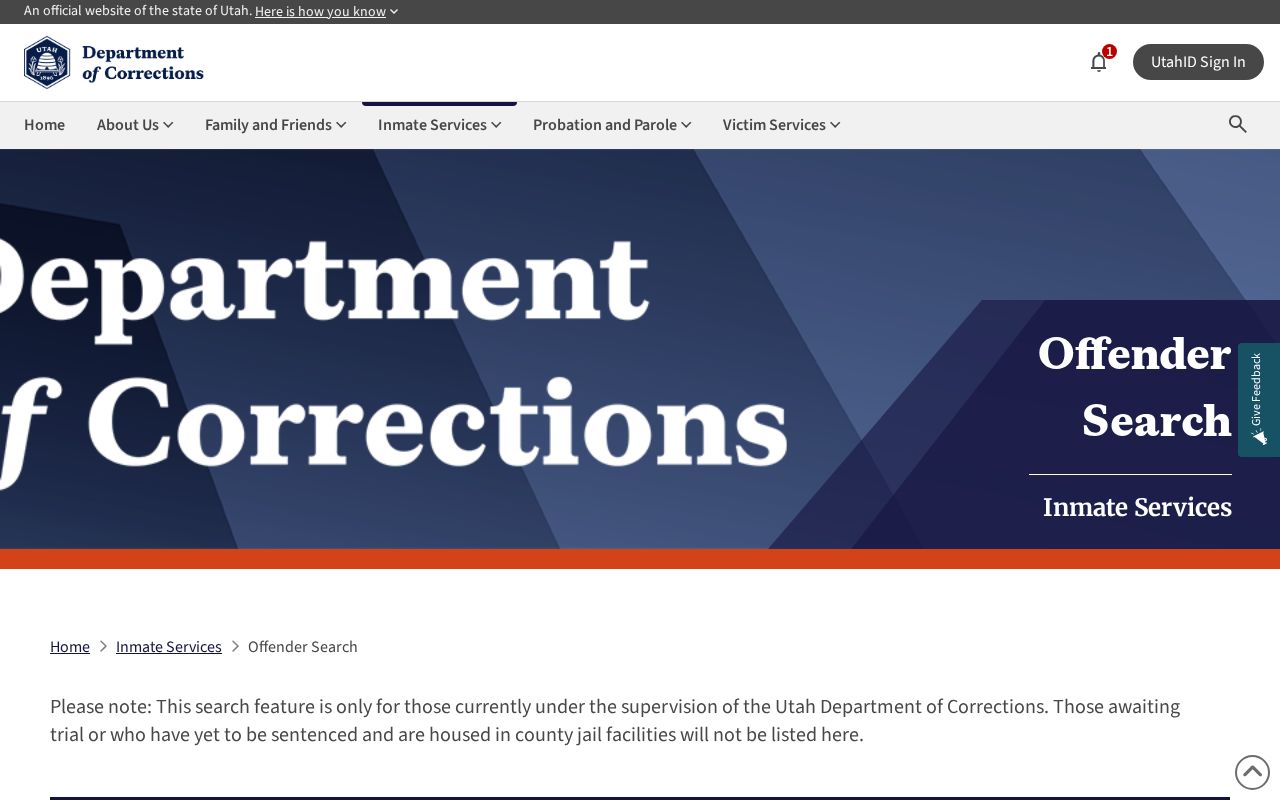
The search result must be opened and read in context because location and date type define whether the person is housed, on parole, or on probation.
Utah Earned-Time Release Rules
Utah does not use one general rule that every prisoner must serve 85 percent. Importing that federal shorthand would misstate the state process. Many Utah prison sentences are indeterminate. The court imposes a statutory range, and the Utah Board of Pardons and Parole decides confinement and release within its legal authority after considering the sentence structure, offense and case record, conduct, risk, programs, and release plan.
Under Utah Code §77-27-9, parole and termination depend on the sentence and statutory limits. An original Board hearing is a decision point, not an automatic release date. A future parole date can be rescinded before the person leaves. Offense-specific minimums and exclusions must be read from the governing statute and actual order rather than reduced to one percentage.
State earned-time credit is governed by §77-27-5.4 and UDC’s approved-program framework. Completion of an approved Case Action Plan program can produce at least four months for each of up to two approved programs. UDC describes a maximum of eight months in mandatory program credit, with possible discretionary cuts. Credit may be unavailable where too little time remains, no current date exists, a release condition remains unmet, or a sentence falls within a stated exclusion. A credit can also be forfeited when a rescission review is required.
Completing a program without a set date does not create one at once. UDC may record the completion for later Board consideration. The Board order and current UDC field remain the sources to read.
The Board combines concurrent and consecutive sentences, applies the legal minimum and maximum, and considers release planning alongside institutional information. Concurrent terms run at the same time, while consecutive terms run one after another. Those labels affect the controlling range, but they still do not yield a reliable public calculation without the actual sentence and Board record.
Common state ranges such as zero to five years for some third-degree felonies, one to fifteen years for some second-degree felonies, and five years to life for some first-degree felonies are statutory ranges, not release formulas. Offense-specific statutes can differ. The exact judgment, case dates, and Board authority control the individual record.
Why Iron County Release Dates Change
A future date reflects facts known when the record was calculated or ordered. Later legal and custody events can move it, cancel it, or change the destination. The cause should be tied to an official record.
| Factor | Possible effect | Record to check |
|---|---|---|
| Board rescission or review | Withdraws or changes a future parole date | BOPP decision and later orders |
| Earned-time action | May advance a state date or be forfeited | UDC calculation and Board record |
| Release contingency | Can delay action until a plan or condition is met | Board order and UDC case record |
| New court order or sentence calculation | May change credit, term structure, or authority | Court docket and commitment |
| Detainer or outside hold | May cause transfer instead of community release | Jail release record and receiving agency |
| Parole violation process | May return a person to custody or set a new path | BOPP and AP&P records |
A detainer is a notice that another authority may take custody. It can make one facility’s “release” a transfer. Iron County’s mixed jail population makes this especially important because a county roster departure may lead to UDC, USMS, another jail, or another authority.
Note: A future hearing date is not a future release date; Board decisions are issued after the hearing and can take time to publish.
Confirm Iron County Actual Release
For a UDC case, compare the current offender detail with the BOPP order. A Location of PAROLE with no correctional facility can confirm that prison confinement ended and community supervision began. That is not full discharge. If the person later disappears from the current-supervision search, obtain the Board termination or expiration order and UDC historical status rather than inferring sentence completion.
Utah VINE can provide advance and actual custody-change notices for covered state cases. Registration and PIN mechanics are detailed on the Iron County VINELink check. UDC and BOPP both warn against relying on VINE alone, so match the alert with the source record and actual location.
For a local jail sentence, request the Iron County release timestamp and type. The court judgment establishes the sentence, but the jail record establishes execution. No statewide Utah rule was found that automatically moves every Saturday or Sunday release to Friday, and Iron County publishes no fixed release-hour policy.
For a future Board event, search the BOPP hearings and decisions portal by first and last name, offender number, or date range. An original hearing, rehearing, paper review, rescission hearing, or violation hearing has a distinct purpose. A hearing date is not a release date, and a decision is not made at the hearing itself. Published Board guidance describes an ordinary decision period of roughly two to six weeks.
Read every later order. A release date granted in one decision can be changed through rescission or another review. A violation case may set a new release or termination path, while a parole warrant can return a supervised person to custody. AP&P status and the current UDC location show whether the ordered change actually took effect.
Iron County Jail Good-Time Credit
County jail good time is separate from UDC earned time. Utah Code §76-3-403 allows the custodial authority, in its discretion and for good behavior, to credit up to ten days per 30 served on covered misdemeanor incarceration. For a term under 30 days, it permits up to two days per ten. The same section can apply to jail imposed as a felony-probation condition unless the district judge orders otherwise.
This credit is not automatic. It is also not the UDC Case Action Plan program credit used for state prisoners. Ask for the commitment, any credit-for-time-served decision, the jail’s discretionary credit calculation, and the actual release record. Applying a state-prison program formula to a county misdemeanor term can yield the wrong date.
Utah Code §77-19-4 addresses temporary or special release for an authorized work or function while the person remains in custody. It is not a broad weekend-release rule. A temporary absence must not be presented as sentence completion.
Credit for time already spent in custody is another distinct input. The sentencing court’s judgment or commitment may state that credit, while the jail applies the local calculation within the order and law. A bond release before judgment is not good-time credit, and probation can begin without a prison release. Keep those events separate when explaining how a date was reached.
If the county calculation is not public online, ask the Sheriff for the existing calculation and release record rather than asking staff to create a new forecast. Utah GRAMA requires reasonable specificity and does not force an agency to compile a custom answer. Include the booking number, sentence case, admission period, and requested fields.
Iron County Contract-Bed Release Dates
Iron County Jail is a UDC Inmate Placement Program site. The official jail-program book identifies ten contracted male UDC beds and approval for added placement. A person can therefore be physically held in Cedar City while the state controls the sentence and projected date.
A disappearance from the county roster may mean that UDC moved the prisoner, not that the person entered the community. Follow the UDC Location, facility, and Release Date/Type fields, then read the Board order. UDC says almost all state releases, including nearly all releases of state inmates held in county contract beds, are processed at Utah State Correctional Facility.
State release processing is generally on Tuesdays. UDC’s published procedure describes support-person arrival times and a process that can take one to four hours, but those logistics apply to UDC cases. They do not set an Iron County bond-out time or a county sentence calculation.
UDC says most state releases are processed at Utah State Correctional Facility, including almost all releases of state prisoners housed in county contract beds. A person may be transported from Iron County before the planned release event. The county roster can therefore change before the state record shows parole or expiration. That movement is part of processing and should not be reported as community release.
A person approved for a community correctional center remains in a structured UDC placement. UDC lists no such center in Iron County. A parolee approved to return to the region may instead report to Cedar City AP&P. The destination must come from the approved plan and actual record, not from the county of conviction.
Verified/accessed August 8, 2026. Recheck live UDC field labels, Board orders, statutes, and jail calculations before relying on a future date.
Public Record Search
Sponsored Results